
2Wire HomePortal 1000HG Wireless ADSL Router
Published on 2007/07/07 by Igor Levicki
Few days ago I laid my grubby hands on a 2Wire HomePortal 1000HG Wireless ADSL Router. It is an older model and as such it is no longer supported or shown on their website. This is how it looks like:


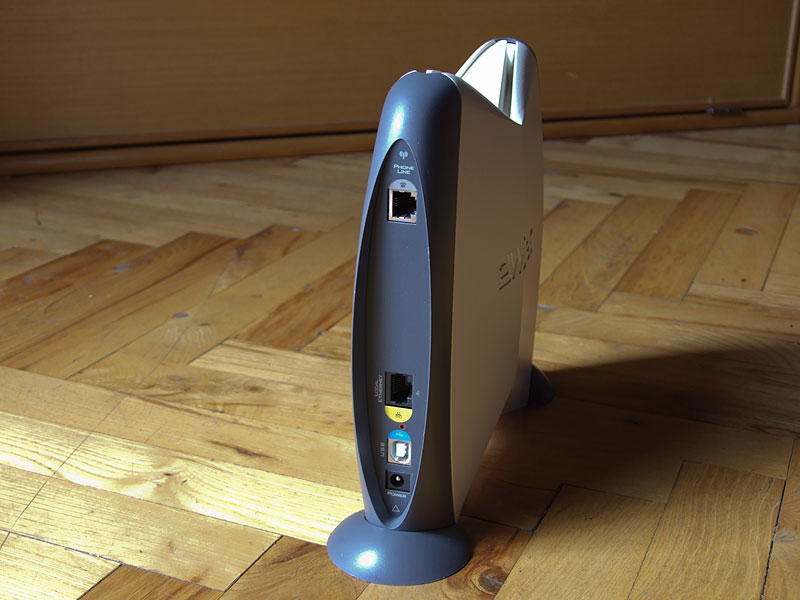
Still it is an admirable unit. The only problem I had was to find power supply strong enough to power this beast. It requires 6V/2A and it seems to me that the rating refers to the continuous draw — it puts quite a load on the power supply. In the end I made one myself from radio shack parts which I had stocked back when my main hobby was electronics.
You get 802.11g (54Mbps), one USB, one Ethernet (100Mbps) and HomePNA conectivity options. If you need more Ethernet ports I suggest getting 1Gbps unmanaged switch (for example TP-Link TL-SG1005D would do just fine) and connecting 2Wire unit to it.
I paid 39 € for the router itself, and I have spent another 40 € on power supply. You must be asking why bother when I could have bought complete unit with similar functionality for the same amount of money? Well, there is the catch — I couldn't.
You see, this router has 1024 entry NAT table meaning that it can handle large number of simultaneous TCP/IP connections. I tested it with up to 400 connections (p2p, bit-torrent) and it worked just fine. It also sports 802.11g (54Mbps) with 400mW output power, and WPA-PSK with TKIP authentication. For ~80 € you can only get cheap chinese crap which chokes and dies with more than 240 concurent TCP/IP connections not to mention terrible and unresponsive user interface.
Another thing worth noting is that you can't buy this router in a store. Those units are branded and tailored for large ISPs in United States and United Kingdom such as AT&T, BellSouth, BT, Verizon, etc. Mine is an SBC unit and it has unlocked firmware so it can be used anywhere as long as you know how to set it up properly for your ISP. You could perhaps find some used units on eBay if you wanted to.
I sincerely recommend 2Wire routers, especially if you tried and you are not satisfied with cheap generic BusyBox 1.0 routers running on those miserable 256MHz MIPS CPUs.